The affordances and limitations of computers for play in early childhood (ED-MEDIA 2008)

ED-MEDIA 2008 paper: The affordances and limitations of computers for play in early childhood

Abstract: The widespread proliferation of computer games for children as young as 6 months of age, merits a re-examination of their manner of use and their facility to provide opportunities for developmental play. This paper describes a research study conducted to explore the use of computer games by young children, specifically to investigate the affordances and limitations of such games and the features of children’s traditional play that can be supported and further enhanced by different kinds of computer play. Computer games were classified and selected according to game characteristics that support higher order thinking. Children aged 5 and 7 were observed playing the games, and a preliminary analysis of findings is given, together with suggestions for further research.

In early childhood development (ECD), spontaneous play is very important. Currently, EC software can be too game-based or too educational.

For ECD, play is a part of socio-emotional and cognitive development. Pretend play lays the foundation for abstract thinking (Vygotsky). It is an early version of role playing.

Children’s play, especially in its make believe or pretending game forms, is a critical precursor to a major feature of our adult narrative consciousness (Singer & Singer 2005)

In the context of play, digital game-based research seriously considers the benefits for teenagers and adults. Not much research has been done on digital games for ECD, hence this study.

Games used in the study included puzzle games (At the Vet’s and At the Doctor’s), an adventure action game (Pajama Sam), and simulation games (Dogz and Sim City). Only two participants (siblings aged 5 and 7); the chief data collector was their mother.

Findings: digital games do support and stimulate pretend play in children. Open-ended games such as simulations, e.g. Dogz, really promoted pretend play. Conclusion: Opportunities for engagement and developmental play exists in the playing of computer games by young children.

———————–
Authors: Irina Verenikina, University of Wollongong, Australia; Jan Herrington, University of Wollongong, Australia; Rob Peterson, University of Wollongong, Australia; Jessica Mantei, University of Wollongong, Australia

Keynote: Playing Games: Hegemony as Enemy (ED-MEDIA 2008)

In the first keynote of ED-MEDIA 2008, Alan Amory, Professor of Education at the University of Johannesburg spoke on Playing Games: Hegemony as Enemy. The talk was deliberately provocative, with a number of game and movie trailers with nudity and profanity — part of the goal “to make the audience uncomfortable”.

He showed the trailer to Memento, a neo-noir crime thriller where viewers need to piece together the story in a detective-like fashion. The film is about memory, masculinity and violence, where maleness is constantly asserted as hegemonic.

He then discussed globalisation and how free trade agreements are really tools for more powerful Western governments to dominate markets that involve weaker countries. How behind the diplomacy, and stock market deals, and oil trades that affect the world, usually are men — power hungry men.

The highest grossing video game of 2007, Halo 3, is essentially about the Rapture, as celebrated by Christian Fundamentalism. The game is riddled with classic Christian good vs evil rhetoric (“judgement”, “fire”, “demons”, “Lords”, “the prophet”, “instrument of God”, etc.) Another hugely successful game is BioShock, set in a city called Rapture. The game is about fascism and anti-Science. The designer of the game is deeply concerned about stem cell research and utopias/dystopias as portrayed by Ayn Rand.

Then, Eyes Wide Shut, a film about a man in crisis. An example of sex as portrayed by men in Hollywood: stylised and essentially without depth.

The overall message is how media, including digital games that are today a key aspect of popular culture, are still male-dominated and based on power and economic models from seventeenth century Europe. Media is a vehicle for propaganda, increasingly embellished with violence, nudity, profanity and religious overtones. Do the games that we play, encourage and design re-enforce these stereotypes? And even educational technology, does that reproduce ideological imbalances?

I enjoyed the presentation. Alan took a risk to present in this way and his message asked interesting questions, which will frame my research on games and educational technology going forward.

A snippet of the presentation is on Qik, the new micro-vlogging service where users can upload/stream video taken by their mobile phones (as opposed to the text-based micro-blogging service, Twitter). The podcast of the keynote is also available.

ED-MEDIA 2008 kicks off

Today the 20th annual ED-MEDIA 2008 conference kicks off at the University of Technology in beautiful Vienna. The official focus areas are educational multimedia, hypermedia and telecommunications. The conference is a truly big affair — Just deciding on which sessions to attend has taken 3 hours of reading. I’ll be presenting a paper on Kusasa on Friday.

Vienna University of Technology

Image by sushipumpum via Flickr (All rights reserved)

The twitterfeed is at twemes.com/edmedia08.

Designing e-learning through games — reconceptualising the 'fun' and the 'serious' in Computer Assisted Language Learning

Bente Meyer
Bente Meyer

At ICeL, Bente Meyer, School of Education at Aarhus University, Denmark, asked: How can we use the learning that children gain from gaming outside of school, in school, specifically for computer-assisted language learning (CALL)?

To answer this question we need to deconstruct and re-conceptualise our thinking about digital games.

The project in which she is involved (spanning 2007-2010) aims to analyse existing learning and serious games and create theoretical concepts about the educational design of games. The oroject is considering 3 games, one of which is Mingoville.com, a web-based platform for language learning for primary school learners (ages 9-12).

Challenges for designing games for CALL:

  • Incorporating learner-driven activities into the design of serious games for CALL.
  • Designing serious games for intrinsic motivation.

I haven’t done a great job of describing the research here — but it is a project in progress. It’ll be an interesting one to watch as gaming and literacy is important for the Shuttleworth Foundation.

Embedding critical thinking into school science lessons

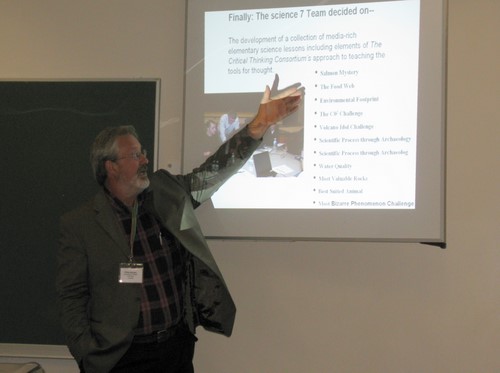
At ICeL, Philip Balcaen of the University of British Columbia (BC), Canada, spoke about embedding critical thinking into science teaching in a secondary school project in BC. His presentation, titled Developing Critically Thoughtful, Media-Rich Lessons in Science, highlighted the need to develop critical thinking skills amongst youth, even while many educators who claim to be in this space do not have a sufficient understanding or definition of critical thinking.

In his paper he outlines a conceptual framework to create critically thoughtful and media-rich science learning resources. The framework is based on a model of critical thinking developed by the Critical Thinking Consortium.

This model supports critical thinking by embedding the teaching of five categories of intellectual tools into the curriculum content. The “tools for thought” include: addressing the need for focused and relevant background knowledge, criteria for judgment, thinking concepts, thinking strategies and the development of habits of mind. Ultimately this approach will develop teachers who can provide ongoing support to the process of inquiry that they have begun.

Philip Balcaen

Philip (above) believes that these “habits of the mind” need to be made explicit outcomes of a lesson. We have planned to discuss this matter further, once he has returned to Canada. The approach used in his framework has great relevance for Kusasa and its lesson formats.

Technology-assisted reading: a helping tool in our crisis

Given that South African learners are of the poorest readers in the world, how do we improve their reading skills using technology? This was the question posed by Gerda van Wyk and Arno Louw of the University of Johannesburg in their ICeL paper: Technology-Assisted Reading for Improving Reading Skills for young South African Learners.

Apparently improving the reading skills of learners through technology-assisted reading programs is a controversial issue: those against it argue that reading on a screen will not improve reading on paper and that screen reading is not a “normal way” of reading. However, there are many voices for it, who acknowledge the role that technology can play in administration, evaluation and being adaptible to learner skill changes.

In an attempt to assess the efficacy and appropriateness of this approach for South Africa (SA), the authors conducted a study with grade 2-7 learners from an Afrikaans medium primary school. The 31 learners in the study came from middle to low socio-economic backgrounds. During 15 sessions — over a period of seven months — the learners followed a combination of a computer-based reading program (software: Reading Excellence), visual accuracy and visual memory computer exercises (software: Lector), as well as the application of specific paper-based activities. Groups were small, with continuous personal intervention and communication from the facilitator with each learner. The reading software automated a spelling test, reading technique exercise, comprehension test and language exercises.

Based on continuous assessment of learners’ performance, specifically reading speed, reading comprehension and spelling, overall improvement was significant. Learners were assessed according to their grade: for reading comprehension the lowest improvement was the grade 3s (18%) and the highest improvement was seen by the grade 4s (65%). For spelling, grade improvements ranged from 19% to 65%. While word improvements were notable, most of the learners still read slower than expected for their grade level.

From interviews, the following overall improvements were identified:

  • Parental feedback:
    • Learners use newly learned words at home during conversations.
    • Learners asked for books from the library for the first time.
    • Learners reading for the first time during school holidays.
    • A general increase in school marks.
    • A change in attitude towards reading and excitement about the reading programme.
    • An improvement in reading speed and reading fluency.
  • Teacher feedback: learners’ confidence improved. Grades in unrelated learning areas improved.
  • Facilitators feedback: the better learners helped poorer readers, open collaboration occurred.

The authors quote Osche (2003) as follows: “Perception of one’s own abilities influences achievement or failure.” As factors contributing to the success of the project, they list: individual attention to each learner, and support from the teachers and parents. The software allowed the learners to work on improving their skills privately, and not through reading in front of a class, something that can have very negative effects on learners’ self-perceptions of their reading abilities.

The presentation was very interesting and I hope to engage the authors as they continue with further research in this space. Their conference paper concludes as follows:

“The results of this study indicate the importance of adapting our teaching methods in order to address the reading crisis in the country. Computer-based reading programs are effective and fairly quick in addressing the reading problems of young learners.”

Indeed, there seems to be real potential for making a significant change in education in SA.

Dr Math going from strength to strength

Dr Math is a maths tutoring service to school learners that uses MXit, the South African mobile instant messenger application. Laurie Butgereit of the CSIR Meraka Institute, Pretoria, presented an update to the project at ICeL titled IM Dr Math: Using Instant Messaging in a Mathematics Tutoring Project.

Points to note since I last blogged about the project:

  • It now runs 2-8pm, Sunday-Thursday, with some 20 tutors.
  • 3,200 learners have used service, some as young as grade 3
  • Tutoring is still mostly done in English, but some Afrikaans cases are occurring.
  • Learners contact Dr Math from many different places, not just their homes, e.g. while on buses, taxis and on the sports field. One learner even contacted Dr Math while in the bath!

It’s great to see such an innovative project develop.

Sitting next to Laurie at the conference dinner she described a simple math arithmetic competition that is now running through Dr Math. Learners answer simple maths questions to compete in real time to be in the ever fluid top 10 list.

We also spoke about the the apparent opportunity for a MXit/MIM-based text adventure/role-playing game to support maths learning outcomes.

It's not about the technology

At ICel 2008 Sue Greener of the Brighton Business School, University of Brighton (UK), presented her research titled Plasticity: The Online Learning Environment’s Potential to Support Varied Learning Styles and Approaches. She used the word plasticity to describe the fluid nature of virtual learning environments (VLEs) that seem to, according to her qualitative study, be able to accommodate most student and teacher learning and teaching styles.

Background to the study:

  • Students make strategic choices about how they use online learning materials and VLEs. Brighton University uses Blackboard and ELGG.
  • Teachers’ use of VLEs likely to reflect their pedagogic beliefs
  • VLE needs to accommodate these two sets of variations
  • Will the variations find a fit? Can the VLE cope?

Each student is different – variations include:

  • Personality differences
  • Different learning style preferences (active, theoretical, practical, etc.)
  • Multiple intelligences
  • Learning motivations
  • Self-efficacy (meaning: we decide whether we can learn something. “Do I believe I’m able to deliver a conference paper?” “I don’t like reading on the screen.”)
  • Readiness for learning
  • Etc.

Each teacher is different – variations include:

  • Pedagogy
  • Prior experience of learning and teaching
  • Relationship with institution — this affects how teachers relate to students and teaching approach

The above teacher factors results in a pre-disposition towards a change in teaching strategy:

  • Is he or she willing to make the move from traditional approaches to a VLE?
  • What about the teachers’ own self-efficacy beliefs about technology?
  • Constraints of VLE itself

These issues all affect whether or not teachers will put materials online, embrace the new technology, strategy, etc.

In Sue’s study she explored teacher “readiness” for online learning. She spoke to HE teachers enthusiastic about online blended learning. Results:

  • Student learning styles could be accommodated by VLE and had little effect on success with students experience of VLE
  • VLE can support multiple styles and strategies

More important is students’ decision to embrace new systems or not. Enthusiastic teachers have a significant influence here. Good online teachers are willing to experiment. Helping students to be comfortable with the ICT system, with searching, reading online, communication and collaborating is crucial.

Conclusion: online learning environments mostly mould to learners’ and teachers’ styles. So, it’s not about the technology, it’s about people.

I asked Sue whether this means that we should focus on champions to spread the word and create momentum? She said that this hasn’t worked at Brighton University. Yes, it works for a small self-selecting group of people who “get it”, but it alienates the bigger group.

The new strategy that they are taking — and they don’t yet know if it works or not — is to seriously consider the large group of teachers who are not digitally literate and comfortable with VLEs, and to take a “customer” view of them. What is their teaching problem or challenge? Understand that and then suggest how VLEs/tech can support them to overcome that challenge. If they see that, then it begins to open a door to the much bigger possibilities that full use of VLEs offer. In other words, show them how the technology can make their lives easier. If it can, you’ll have a good “in.” If it can’t, then they probably don’t need it.

International Conference on eLearning (ICel) 2008 kicks off

I’m at the 3rd International Conference on eLearning being held at the University of Cape Town. 130 delegates from 20 countries are here. The program includes interesting aspects of this very broad theme. I’ll be blogging about projects and research of interest to the Communications and Analytical Skills development theme.

Laura Czerniewicz opening the conference

Image: Laura Czerniewicz opening the conference

The need for localisation of serious games

Last week was the 5th annual Games for Change conference in New York. An interesting blog post to come out of that discusses the need to localise social issue games. In the post Suzanna Samstag Oh talks about creating a social issue game for Koreans, by Koreans, about a Korean issue. Why not just use an existing game about, for example, the global energy crisis? Because cultures are different and respond differently to crises. They have different social norms about public dialogue, being critical or collective response. Thus to get the most impact out of social issue, or serious, games, it is necessary to fully localise these to a particular culture.

The bottom line: South Africa will need it’s own serious games about xenophobia or unemployment or HIV/AIDS.