Ushahidi: crowdsourcing crisis information

At Web4Dev, Erik Hersman, the White African, spoke about Ushahidi, a free, open-source platform to crowdsource crisis information. It allows anyone to submit crisis information through text messaging using a mobile phone, email or web form.

It has been used to report on the botched elections in Kenya, the DRC and the war in Gaza.

Crowdsourcing Crisis Information

The next big thing for Ushahidi: how to overcome information overload. Taking all of the SMS reports and filtering the huge amount of data. Since the Mumbai bombings they’ve been working on a project called SwiftRiver, which is focussed on making sense of information received in the first 3 hours of a crisis. There are machine and people ways to filter the information — they’ve chosen the people approach.

The motto of the project: if it works in Africa, it will work anywhere.

Assist New Culture Learning with a Mobile Group Blog (ED-MEDIA 2008)

ED-MEDIA 2008 paper: Assist New Culture Learning with a Mobile Group Blog.

Abstract: Cultural shock and adaption are ubiquitously existing problem among the international students who newly arrive in the UK. This research examined a new way of forming online community with mobile devices helping overseas students successfully adapt to the new environment after arrivals. In this pilot study, a group mobile blog, Nottsmoblog, was designed and developed to a group of Chinese overseas students in Nottingham, UK. During the month of this study, each of the participants held Nokia mobile phones for group blogging, sharing their findings and personal experiences about the adaption and discussing within the group blog site. Different levels of cultural awareness were found in the group and people got increasingly awareness and more motivation to learn the local culture through their blogging activities.
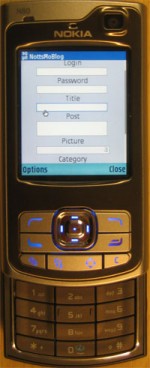
Posting to NottsmoblogBlogging through mobile devices — moblogging — provides the opportunity to “capture the moment,” “on the spot.” A mobile group blog, with multiple authors, is a shared space which can create a sense of community between the bloggers. In this study:

  • 12 Chinese students moblogged for 4 weeks directly after arriving in Nottingham
  • They used internet-enabled phones and posted to their WordPress blog via a page customised for mobiles (see image)
  • Most posts were anonymous
  • 239 posts, 184 comments
  • The site received 2,847 hits with 218 login visits and 1,798 site pages viewed

They also created a short video using their camera phones: “A day in Nottingham.” Scenes include: Queuing to get onto a bus, getting onto the bus and buying a ticket. A market scene. A lone protester with a poster — free speech, new to the Chinese students. A funny British post-card — the Chinese girl explains to her friend that in the UK they find self-mockery humorous. Robin Hood museum. Etc etc.

When moblogging the students can send a photo, text and choose a category. Most posts covered the categories: life, buildings, food and traveling.

The author observed (not measured) the following links between blogging activities and thinking skills:

Mobile learning activities Thinking skills
Awareness Inquiry skills
Information gathering Information processing skills
Information transfer Reasoning skills
Information sharing Collaboration skills
Feedback Evaluation skills


Student motivation for moblogging:

  • Sharing experiences
  • Expecting comments

Time and place of moblogging:

  • Needed time to edit and choose photos to upload
  • Needed a place to sit down to upload
  • Asked for new input methods other than text

New opportunity for language learning:

  • Of interest was the unconscious shift in language use of a few students from mother-tongue (Chinese) to English after a few weeks of moblogging

Usability feedback:

  • Poor quality of photos taken by mobile camera
  • Inconvenience of inputting personal logging information

Privacy and security:

  • Students noted the need to keep blog audiences in mind before blogging
  • Students wanted more people to join in
  • There was mutual F2F communication between the students beyond the blog (they did not know each other before arriving in Nottingham)

Conclusions:

  • Students are very happy to share their experiences with people not only with the same background but also with people from diverse cultures, including local people
  • Young people are fascinated with the changes brought about by new technology in their daily life
  • The information they captured and stored in the group blog helped them recall their experiences
  • All of them would like to know more people who are in similar situation as them, with the aid of online community

In addition to being useful to immigrants, it could also be used for people moving from rural areas to cities. Businesses could also have their employees use such a service when they are moved between countries. Before moving to Shanghai (with the Ambassador Relocation or any other quality service), a US-worker could read the blogs of others who have gone before her and prepare for the culture shock.

——————

Author: Yinjuan Shao (aka Peggy),  LSRI University of Nottingham, UK

ProBoPortable: Development of Cellular Phone Software to Prompt Learners to Monitor and Reorganize Division of Labor in Project-Based Learning (ED-MEDIA 2008)

ED-MEDIA 2008 paper: ProBoPortable: Development of Cellular Phone Software to Prompt Learners to Monitor and Reorganize Division of Labor in Project-Based Learning.

Abstract: The authors developed a cellular phone application which displays information regarding progress and achievement of the tasks and division of labor in project-based learning (PBL) in higher education. The ProBoPortable application works as wallpaper on the learner’s cellular phone screen, and cooperates with a Web-based groupware. When a learner activates his/her phone, ProBoPortable immediately retrieves the current status of the project from the groupware database and displays the status on the screen. Classroom evaluation was performed in an undergraduate course, which confirmed that ProBoPortable enhanced mutual awareness of the division of labor among learners, who modified their own tasks by monitoring the overall status of the PBL. The sense of learning community was increasingly generated by using ProBoPortable. Moreover, social facilitation encouraged the learners to proceed with their own task due to the presence of others who are mutually aware of each member’s status.

A sense of learning community is important to motivate and stimulate students’ learning in a distributed platform (Palloff & Pratt 1999). ProBoPortable increased this sense of learning community.

In SA, could this approach be used with a product such as MXit?

———————–
Authors: Toshio Mochizuki, Senshu University, Japan; Hiroshi Kato, National Institute of Multimedia Education, Japan; Kazaru Yaegashi, Ritsumeikan University, Japan; Toshihisa Nishimori, The University of Tokyo, Japan; Yusuke Nagamori, University of Tsukuba, Japan; Shinobu Fujita, Spiceworks Corporation, Japan

Nokia study predicts rise of 'circular entertainment'

A new study from Nokia and The Future Laboratory predicts that by 2012, a quarter of all entertainment will be “circular”, that is created, edited, and shared within peer groups rather than being generated by traditional media. The bulk of the study was based on interviews with trend-setting consumers from 17 countries about their digital behaviors and lifestyles.

Mark Selby, Vice President, Multimedia, Nokia, said: “The trends we are seeing show us that people will have a genuine desire not only to create and share their own content, but also to remix it, mash it up and pass it on within their peer groups – a form of collaborative social media.” The term circular is based on the movement of content: it is created, shared with friends/family, gets edited/remixed and then shared on or returned again.

As Tim Leberecht of CNet says, one has to take these vendor-funded studies with a pinch of salt. He makes an interesting point about the study: that the distinction between traditional and “circular” entertainment is becoming increasingly difficult to define. But still, for what it is worth, the tech early adopters in these countries are living in and establishing a participatory culture.

I wonder, since the data is based on the actions of early-adopters, how much of this applies to South Africa (SA)? If the prediction is five years out, is it any more for SA? And if yes, how many more years? Only two of the 17 countries are traditionally comparable to SA: Brazil and India. Reading about the survey findings there didn’t help to answer these questions, but it does make for interesting reading.

Informal (m)learning: youth and camera phones

The Red Victorian, San FranciscoMy world through my camera phone describes a project about a group of teenagers from San Francisco and Pretoria who used camera phones to document aspects of their lives, post the material online and to engage each other around that. Every week I would meet with the group in San Francisco to discuss that week’s tasks, which were related to capturing and conveying aspects of their individual culture: their family roots, the food they eat, the music they like, their community, etc. While much more research is needed, the project demonstrated that mobile phones and blogging, supported by in-person group discussions, are useful tools to foster cross-cultural awareness.

The project began to answer questions such as:

  • How do youth socially and communicatively interact with their mobile phones?
  • How can mobile phones be used to document their lives?
  • And in a world of global communications, can this mobile device be a conduit for increased cross-cultural awareness and sensitivity?

Image taken with a camera phone by Ben Dunning, 14 (CC)