This morning I delivered a keynote presentation at the Schools ICT Conference in Cape Town. The conference is attended by 500 people, mostly teachers, and is about the use of ICT in education.
My presentation The cellphone: ultimate distraction or powerful learning tool? is about the growing disconnect between childrens’ learning experiences in classrooms and outside “in the world.” I propose the cellphone as a tool that supports formal education and also informal learning, and thus as a way to span these disconnected sites of learning. (Children have multiple sites of learning, e.g. school, home, playground, etc.)
Two projects that I highlighted: Dr Math and M4Girls. Two suggested projects: an alternate reality game using cellphones and m-novels, short stories serialised into daily chapters, delivered on cellphones. The phone is used as a reading and authoring platform.
A very interesting perspective presented by Prof Anna Sfard is that Maths should not be used as a ’measure of intelligence.’ Read the piece, it’s short and thought-provoking.
An article on games and learning that appeared in the Business Day on Fri, 26 September, with some quotes from me, Alan Amory and Danny Day. Most of the facts are right 🙂
The Centre for Development and Enterpris (CDE) held a workshop entitled Doubling for Growth, to discuss ways to address the maths and science challenge in SA’s schools. A report with the same title was published last year that presented a plan to double the number of maths and science matriculants.
The workshop was meant to reflect on progress and challenges since the report, and open the discussion to a wider audience that also wants those kinds of results for maths and science.
It was attended by a number of private companies that invest in the “maths and science problem” as part of their CSR spend. They also need those graduates as future staff.
Issues:
Corporates and government are investing large sums of money but are seeing very little impact.
Interventions produce small numbers of graduates, e.g. one company supported 8 matriculants per year.
Not enough sharing of resources and efforts between players in this space.
How to measure the impact of the various singular efforts to address the problem?
Ann Bernstein, head of CDE, gave a presentation that covered the following:
Challenges in contemporary SA schooling:
Lack of accountability
Poor management
Low time on task (46% of teacher time is spent actually teaching — this should be 85%)
Slow pace and incomplete coverage of curriculum
Poor teacher competencies: precise facts about teacher qualifications in SA are not known
Maths teaching poor all the way through
Language of instruction (LOI) is not the mother-tongue language of many learners
220 Dinaledi schools (out of 400) where no impact is seen on HG maths passes
New curriculum has huge implications for teaching capacity:
2007: 275,000 SC learners doing maths HG or standard grade (SG)
2008: > 500,000 doing maths or maths literacy
Many more teachers are needed!
Far too few high performing schools:
2004-2007: SA is stuck on around 25,000 HG maths passes per year
0.5%: number of African matriculants who wrote higher grade (HG) maths and got a “C” or above (2004)
50% of public schools do not produce one single Senior Certificate (SC) HG maths pass
More than half of HG maths passes come from ex-model C schools. There is no guarantee that these schools will keep producing. They also face pressure to perform! Focus should not only be on the poorest of the poor and the low-end schools; these well-performing schools should be supported.
CDE recommendations:
To strengthen the Dinaledi programme: introduce a contract between schools and the DoE.
Identification of talented learners
New capacity in the DoE. Need strong communication from the DoE on the issue.
Teachers: test them. Need an audit and supply plan. Not enough data on this, not enough being done about it. Need more qualified teachers NOW for January 2009 — must IMPORT!
About 80% of public schools are dysfunctional. National voluntary apptitude test. Commit to get those kids to a decent school. Will need bursaries/support.
Private sector: current approach is not working, not fundamentally improving the education system. Ad hoc interventions are helpful, but not enough. The private sector must not perform the state’s role. They should use their private resources as “risk capital” to test innovative ideas that can go to scale.
Make “Doubling” a national project:
Need to strengthen and expand the Dinaledi programme
Need HG candidates from outside the Dinaledi schools
Take a “SARS approach” and create a unit to run the Doubling project: Executive leadership; Comprehensive strategy; Bigger budget and staff; and Report to parliament every year on progress
CDE proposed an ongoing private sector/foundation forum to:
Discuss and agree on advocacy points of leverage for new the government.
Discuss how to invest in the M&S problem with a “risk capital” approach, and partner with organisations that can take interventions to scale.
The BBC reports that a daily dose of computer games can boost maths attainment, according to a study carried out in Scottish schools.
The study involved more than 600 pupils in 32 schools across Scotland using the Brain Training from the Dr Kawashima game on the Nintendo DS every day.
Researchers found that while both groups — the control and experiment group — had improved their scores, the experimental group using the game had improved by a further 50%.
What’s interesting here is that most game literature likes to promote complex games as the vehicle for real learning, but this study shows that even drill-and-practice games help, if improving maths scores is what you want to achieve.
I recently attended the Rural Education Project (REP) Conference. The theme: Towards quality learning and teaching. Between 2006 and 2009, REP aims to develop the literacy and numeracy skills of primary school learners in under-resourced rural schools.
At the Rural Education Project conference
The project, part-funded by the Claude Leon Foundation, is interesting in that it did not set out to look for the one magic bullet in education, but rather aimed to critically explore and measure differentiated approaches to improving education in 38 rural case schools.
Essentially, the project is based on an experimental programme approach: which approaches work in which schools under which conditions? Levels of engagement occurred at district, community, school and classroom levels.
Cally Kuhne, REP project manager, pointed out the benefits of this approach:
Contribute to knowledge on rural development, in particular numeracy and literacy improvement, to inform practice and/or policy.
Identify contextual challenges related improving quality of teaching and learning in rural schools.
Study issues related to improving results.
Examine unique features of each school/cluster.
Enrich understanding of current practice, programmes, institutions and systems.
The final findings of REP will only be written up next year. For now the two-day conference was a taster — and an opportunity to network and share opportunities and challenges facing rural education. My conference notes provide details on the various presentations.
Clifton Frolick, Director, Cape Winelands Education District spoke about Rural education: Challenges and possibilities:
Rural education (RE) refers to rural town schools, farm schools and multi-grade schools. Most schools in rural areas are multi-grade.
Context for RE initiatives: MDGs, AsgiSA, JipSA.
Features/challenges of RE:
Poverty, underdevelopment
Unqualified or under-qualified teachers
Isolation of teachers (not tapped into social networks) (I think that Siyavula can help here!)
The language of learning and teaching (LoLT) differs from mother-tongue
No adequate teachers in the Maths and Science
Lack of critical skills amongst learners
Limited access to ECD programmes
Lack of understanding of local and global environment
Absence of adequate transport for learners to/from school
Cost of school uniforms
Failure to complete FET
Hunger/illness/HIV-AIDS
Lack of basic services
Lack of ICT resources
Minimal district support
A framework for action
Improving quality of teaching and learning
Improving infrastructure
Strategies to attract and retain learners
Building partnerships to enhance community development
I can’t help thinking that many of these challenges also face urban and peri-urban schools that exist in under-resourced areas. A defining feature of the rural context, of course, is geographic isolation, which only exacerbates the perception, held by many teachers, of not being supported in their work. Any RE strategy must therefore have a local community focus.
Diane Hendricks: Changing hearts, changing minds at whole school level: Curriculum management as an entry point for whole school development. Below are interesting quotes and references that she gave about educational change as well as the role of the teacher.
David Hopkins argues that the complexity of changes in education challenges those involved to make huge shifts in order for impact to be seen at classroom level. “Such shifts in understanding and beliefs are difficult to achieve, but without them we will continue to wallow helplessly in the face of the inevitable” (Hopkins, 2001: 35).
We should also bear in mind that the factors that facilitate or inhibit change differ from school to school. Fullan, states the following, “The number and dynamics of factors that interact and affect the process of educational change are too overwhelming to compute in anything resembling a fully determined way” (2001)
The successful implementation of the NCS depends and relies heavily on what the teachers do in educational institutions. No effort at educational change can ignore the pivotal role that teachers have to play in order to ensure implementation of any kind.
Fullan (2001:70) states the following: “Many attempts at policy and program change have concentrated on product development, legislation and other on-paper changes in a way that ignored the fact that what people did and did not do was the crucial variable.”
In an article of The Educator’s voice, South African Democratic Union writer Sherman Mannah highlights the capability of teachers by stating the following: “The role of educators as active agents of change in society cannot be overemphasized.” (1999)
Books:
Developing Teachers: The Challenges of Lifelong Learning by Christopher Day – 1999. Teachers who wanted to improve their practice were characterised by four attitudes: they accepted that it was possible … to improve, were ready to be self critical, and to recognise better practice than their own within the school or elsewhere, and they were willing to learn …
Change Forces: Probing the Depths of Educational Reform by Michael Fullan – 1993. “… and hence that professional development was a never-ending process, a way of life.” ( p. 72)
Changing Teaching, Changing Times: Lessons from a South African Township by J. Clark, C. Linder – 2006. And finally, like the teachers in Nias et al.’s (1992, p. 73) study, “she was willing to learn what had to be learned in order to be able to do what needed or had to be done.”
Anthea Roberts: Why a text book series as a structured, systemic intervention approach? — regarding the SDU’s Maths for all textbook series:
Their baseline studies (Primary Education Upgrading Programme and the District Development & Support Programme) revealed that teachers have too many text books. They use a bit from this book, a bit from that book. Insight: Standardised teaching and learning support materials can be one of the most effective ways to support less-experienced and under-qualified teachers.
Adequate resources are necessary but not sufficient to improve delivery. Schools have large quantities of learning resources. Teachers not trained to use them effectively.
Anthea then spoke about Beeby’s four stage model of professional teacher development (1966) as a helpful way to categorise schools on a developmental ladder.
Stage 2 — teachers are still insecure: open to change but easily discouraged. Siyavula can help here.
Who will mentor teachers from stage 2 to 3, and ultimately to stage 4?
Chester Davids, teacher from Citrusdal:
He unpacked the jarring transition for learners from Foundation Phase (grade 3) to the Intermediate Phase (grade 4).
He suggested interesting approaches to preparing the teachers as well as the learners to make the transition.
Gary Powell and Kaashief Hassan: Developing and sustaining effective learning and teaching using electronic media supported by an electronic communication network:
Baseline problem: group of schools targeted performed poorly in gr 3 and gr 6 assessment tests.
Remedial development and support for learners hampered by isolation of schools and distances between them.
One solution: use effective elearning tools.Support teachers with:
electronic media, e.g (DVDs, CDs, etc.)
electronic neworking: email, cellphone, SMS, telephone and fax
online collaboration: chatrooms, blogs, wikis and LMSs
website searches and sourcing of learning materials
Although, challenges abound! In many situations, the computer room is not effectively used.
Gary and Kaashief often present at ACE classes. Interesting ideas above – will definitely keep in touch.
Brenda Sonn and Karen Collet, Teacher Inservice Project (UWC): Reflection on project implementation. They interviewed many teachers and principals — some key points below.
Cami Maths and Cami Reading software captures learner data, but this is not mined.
Recommend: management should encourage to share good examples of teaching strategies, lesson plans, and assessment tasks as part of their curriculum and professional development.
For headmasters to champion instructional leadership, they need time and therefore cannot be full-time teachers themselves.
Parental support is almost non-existent in RE. They are often illiterate and very poor. Is it a middle-class Western expectation for parents to be fully involved in their childrens’ homework? Quite possibly.
Two ways to work around this:
After-school facilities where homework can be done.
Giving learners very basic homework to do at home — that other kids, e.g. siblings, and parents can help with.
TIP is an independent education research unit at UWC.
Dr Ronald Cornelissen, Deputy Director General, Research Services, WCED: Contextualising the Grade 6 Diagnostic Test Results:
In the 2003 and 2005 tests, samples were used. 2007 test: all learners were tested.
Schools in quintile 5 — the richest or “least poor” schools — perform the best.
Learners are struggling most with: Fractions, division and multiplication.
Very NB to look at average results, possibly a more important figure than the pass rate.
The percentage of learners who are pushed through grades vs the test results is frightening, e.g. 97% of learners made it through grade 6, but only 14% got more than 50% on the standardised numeracy test. Is the test too hard, or are individual school standards too low and thus learners pushed through too easily? An audience member remarked that the tests show that the “wholesale, romantic pretense that kids are passing” is totally untrue.
Panel: Towards quality teaching and learning:
Sociological reality in this country that children are in trouble. Gangsterism, drugs, illiterate and uninvolved parents, violence, HIV/AIDS, hunger, etc. etc.
Joey Daniels: Gone are the days of schools competing with each other. The new thinking is around collaboration and sharing of ideas. They’ve started a Maths and Science school for gifted learners.
Susan Meyer and Cally Kuhne: Research directions for REP:
What the diagnostic test stats don’t tell us: pass rates in relation to learner age, school size, ex-Department, geographic location (relative isolation). They’ll talk to Tim Dunne about this.
Final notes:
Am going to meet with Gary and Kaashief, to talk about further research to do with REP, either funded entirely by SF or as SF partnering with Claude Leon Foundation.
IT usage in schools
Which ICTs are best suited to particular contexts/needs, e.g. to foster communication between teachers use SMS over email
Pre-service teachers: ICT-literate ones, involve in gaming, mlearning pilot?
Spoke to Susan Meyer about school typologies. We should keep talking about how to extend this with REP data, Beeby’s work, etc. She is an independent education researcher.
Jonathan Clark (UCT SDU). Talking about education research, he used the metaphor of prospecting for oil. You can’t scratch on the surface, you need to drill narrow and deep over an area and begin to map out the terrain.
Anyone in South Africa that runs a participatory learning project that they want to scale, but need the financing to do so, should check out the Digital Media and Learning competition — funded by the MacArthur Foundation.
Innovation in Participatory Learning Awards
Innovation Awards $30,000 – $250,000
Deadline: October 15, 2008
Innovation in Participatory Learning Awards support larger-scale projects that demonstrate new modes of participatory learning in a variety of environments, by creating new digital tools, modifying existing ones, or using digital media in novel ways. Collaboration is strongly encouraged. International applications are welcome from eligible organizations.
(When I was at the Games+Learning+Society Conference in the USA, many of the games and research had been funded by the MacArthur Foundation.)
Yesterday the second Games and Learning Indaba took place at the University of Johannesburg. It was very different to the first indaba held in Cape Town, I think largely because more game developers attended the Jo’burg event. In total 33 people attended, including researchers from the Meraka Institute and various universities, members of civil society organisations (e.g. SANGONeT and Women’sNet) and a number of teachers.
At the Games and Learning Indaba in Johannesburg
As in Cape Town, the reason for the event was to explore the potential that digital game-based learning holds for education (formal) and learning (informal) in South Africa (SA), especially in improving communication and analytical thinking skills.
Why did people attend the indaba? Game developers wanted to make connections with researchers and ask: are they gamers themselves? Is their work grounded in reality or based on assumptions? Researchers wanted to meet game developers. One attendee came to find out if anyone knew of a game that is as addictive as a first-person shooter, but not as violent. Civil society people wanted to know more about using games for social change, in other words, about serious games. A game developer wanted to know what companies expect to pay for games.
While not all of these questions were answered, what clearly emerged from the session was an interest between game designers and developers, academics and teachers to work together to create, pilot and evaluate games. This will be challenging, as the some of the heated discussions demonstrated, because each of these groups have different interests that motivate them.
A number of game development challenges were discussed:
It takes an enormous amount of time – and is therefore very expensive.
It requires specialist skills, often not found in SA.
The different belief systems and ideas between designers and developers need to be negotiated during the creation of the game.
I gave a short presentation on two gaming conferences that I recently attended.
As in Cape Town, Professor Alan Amory presented again. This quote sums up one of his fundamental beliefs about games and learning:
I don’t think you learn from technology, you learn with technology. When you are designing a learning activity, that is the object of the exercise. The tools, e.g. games, that you use to mediate that learning can be very complex or very simple. That’s a very different way to think about games. It’s not the thing – the game – that is important, it’s what you do with the thing that counts.
All games are socially constructed and have ideologies embedded in them, e.g. those of the game designers and developers. That is why there are games that promote gender bias. That doesn’t matter as long as the game is used as a tool to explore the topic of gender. It is essential to deconstruct these socially constructed artifacts. The process of deconstruction, where the game is used as the discussion starter about violence, gender bias, male dominance, etc. is where the real learning with games occurs.
A point that everyone seemed to agree upon was that gaming, as an element of an increasingly digitally mediated world, is forcing educators to rethink how they teach and how learners learn at a very fundamental level, in a way that talks to youth today.
As the discussions continue on the Games and Learning in South Africa Google Group, we will hopefully see more perspectives, collaborations and findings emerge that will help to exploit the learning potential of games.
At the Shuttleworth Foundation we seek innovative ways to improve the communication and analytical thinking skills of youth in South Africa (SA). One of the ways to potentially develop these skills is through digital gaming — be it on a PC, mobile phone, platform (e.g. Sony PlayStation), handheld (e.g. Nintendo DS) or some other device.
The question we are currently asking ourselves is: What potential does digital game-based learning hold for education (formal) and learning (informal) in SA, especially in improving communication and analytical thinking skills?
To begin to answer this question, I hosted the first Games and Learning Indaba (workshop) at the Foundation in Cape Town last week. The indaba had three overall aims:
To explore the state of gaming amongst youth in SA;
To identify opportunities for using games in education and learning; and
To identify barriers to increased use of games in education and learning.
At the Games and Learning Indaba
While there is interesting and relevant research about games and learning coming out of the developed world, not much research has been conducted in SA. Our context is significant: we have a particular education system with its own strengths and weaknesses; our society is multilingual and multicultural; and the access to technology for our youth is varied and vastly different to, say, that in the USA. It is therefore important to understand the opportunities, challenges and findings here.
Twenty people attended the indaba, collectively representing game designers and developers, academia, university students, the Western Cape Education Department, creators of educational content, and marketers. Sadly, no learners attended; we tried to get a few there but they had to attend school!
When asked what they were expecting to get out of the indaba, attendee responses included: to get ideas for a particular game, to join a network of practitioners and researchers in this space, to see how more game-like activities can be used in school computer labs, or simply to find out more about games and learning.
Elaine Rumboll, Director of Executive Education at the UCT Graduate School of Business, described how many corporate executives were very excited about the prospect of gaming as a way of embedding learning back in the workplace. She is currently developing a game for a corporate client and wanted to connect with a group in this space.
First off, to get to know each other the attendees did some “speed dating” — meeting a stranger in only three minutes before moving on to someone else.
Professor Alan Amory, a well known game studies researcher from the University of Johannesburg, gave the first presentation — Social constructivism in games based learning in the South African context — on game design, development and research that he and others conducted with previously disadvantaged youth in SA. They found that the highest levels of learning were achieved when there was social dialogue between game players (learners playing a game in pairs as opposed to playing alone). Their conclusion: people learned not from the games but rather with the games as they tried to solve the game problems together.
Marion Walton, senior lecturer at the Centre for Film and Media Studies, UCT, gave a fascinating presentation titled Beyond communities of practice: Understanding informal learning in online games. As part of her PhD, she joined two guilds in the massively multiplayer online role-playing game (MMORPG), World of Warcraft. Much of the current game literature portrays online gaming communities — in actual games and also on forums, mailing lists, etc. where games are discussed — as close-knit places of informal learning, mentorship and inclusion (what Gee calls “affinity spaces”). While this is true for some communities, it is certainly not true for all, as Marion discovered.
The World of Warcraft guilds she tried to join were rife with prejudice, sexism, overt masculinity and profanity. These “tribes” are highly exclusionary, with wannabe members needing to jump through humiliating hoops to join, and then play along within the harsh social hierarchies of the tribe if they manage to be accepted.
Marion’s thought-provoking research thus questions the often celebratory view of online gaming communities. Her presentation highlighted a challenge for those wanting to use games for learning and education: How to allow communities to develop that do not replicate the prejudiced practices found in the offline world? This question was discussed in light of the recent xenophobia attacks in SA.
From group discussions during the indaba, some of the challenges identified for games and learning included copyright laws in SA, the cost and logistics of distributing games, lack of funding for game development and research, the need for a more active game development industry in SA, and the challenges of incorporating gaming into classrooms.
A particularly interesting perspective was this: “When it comes to the use of educational technology, we often have to find ways for learners to ‘leapfrog’ over teachers, who are less tech-savvy.”
Overall, I was very happy with the indaba as the first tentative step to critically explore the space between “moral panic” — (“games are violent, addictive and a waste of time”) — and “blind faith” — (“gaming is the only future”), concerning games and learning. The varied group generated different perspectives on the games and learning space. Certainly there was much enthusiasm, interest and a desire for more events like this. I created a Google Group to support an ongoing dialogue on this topic.

 The
The 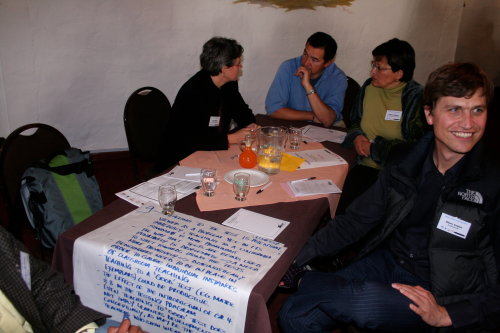
 Anyone in South Africa that runs a participatory learning project that they want to scale, but need the financing to do so, should check out the

 Steven Vosloo