Virtual Worlds: Exploring Potential for Educational Interaction (ED-MEDIA 2008)

ED-MEDIA 2008 paper: Virtual Worlds: Exploring Potential for Educational Interaction.

Abstract: Interaction is widely accepted as essential for learning. The challenge of distance education is to overcome transactional distance through provision of appropriate opportunities for interaction. Asynchronous and synchronous computer-mediated communication via text, audio and video has done much to reduce transactional distance. 3D online spaces may offer further opportunities to reduce transactional distance but it will be necessary to identify the most appropriate forms of interaction to be included in learning environments using such spaces. As an aid to investigating possible applications of 3D online spaces in distance education some means of mapping out the territory to be explored is desirable. This paper proposes one such map and suggests examples of applications that might be explored in various areas of the map.

An excellent and very interesting presentation on the nature of distance education (DE). Apparently research that compares the quality of learning that happens through distance education vs face-to-face (F2F) shows no difference between the two.

The author considered the issue of transactional distance — e.g. the “space” (physical, psychological, etc.) between the learner and the teacher — which is often biggest in DE projects. However, there is also some transactional distance in F2F classrooms. How can technology, in particular virtual worlds, be used to reduce transactional distance on three levels of interaction:

  • Learner to content?
  • Learner to teacher?
  • Learner to peers?

Peter proposed a cube to visualise the interaction between learner and the three axes above. By conceptualising DE in this way it becomes easier to design DE environments (being able to actually design such spaces is a relatively new affordance; in the bad old days, DE projects relied on snail mail communication!)

If Kusasa, the Shuttleworth Foundation project, ever had to employ a  virtual world for learner activity, it would be based in the cubic block that represents high learner-to-content, high learner-to-learner and low learner-to-teacher activity.

Peter Albion

———————–
Author: Peter Albion (above), University of Southern Queensland, Australia

ProBoPortable: Development of Cellular Phone Software to Prompt Learners to Monitor and Reorganize Division of Labor in Project-Based Learning (ED-MEDIA 2008)

ED-MEDIA 2008 paper: ProBoPortable: Development of Cellular Phone Software to Prompt Learners to Monitor and Reorganize Division of Labor in Project-Based Learning.

Abstract: The authors developed a cellular phone application which displays information regarding progress and achievement of the tasks and division of labor in project-based learning (PBL) in higher education. The ProBoPortable application works as wallpaper on the learner’s cellular phone screen, and cooperates with a Web-based groupware. When a learner activates his/her phone, ProBoPortable immediately retrieves the current status of the project from the groupware database and displays the status on the screen. Classroom evaluation was performed in an undergraduate course, which confirmed that ProBoPortable enhanced mutual awareness of the division of labor among learners, who modified their own tasks by monitoring the overall status of the PBL. The sense of learning community was increasingly generated by using ProBoPortable. Moreover, social facilitation encouraged the learners to proceed with their own task due to the presence of others who are mutually aware of each member’s status.

A sense of learning community is important to motivate and stimulate students’ learning in a distributed platform (Palloff & Pratt 1999). ProBoPortable increased this sense of learning community.

In SA, could this approach be used with a product such as MXit?

———————–
Authors: Toshio Mochizuki, Senshu University, Japan; Hiroshi Kato, National Institute of Multimedia Education, Japan; Kazaru Yaegashi, Ritsumeikan University, Japan; Toshihisa Nishimori, The University of Tokyo, Japan; Yusuke Nagamori, University of Tsukuba, Japan; Shinobu Fujita, Spiceworks Corporation, Japan

Multimedia and multiliteracies in the early elementary years (ED-MEDIA 2008)

ED-MEDIA 2008 paper: Multimedia and multiliteracies in the early elementary years.

Abstract: The widening of the concept of literacy has many implications for teachers. In this paper three classroom activities will be discussed and linked to concepts of ICT literacy and to questions of pedagogy when language, media and computing combine in the classroom. The first activities were carried out by five and six year old students exploring computer graphics and text. The other activities were used with grade 3/4 students, and involved graphics, text and sound to illustrate or explain specific contexts or situations.

The author spoke about the need for children to reflect on their use of technology to really develop higher order thinking skills. In his examples, working with an inner-city primary school in Melbourne, the teacher would guide a class discussion during or after the learners used software to create digital artefacts. To back this up this approach he quoted the paper Literature Review in Thinking Skills, Technology and Learning.

The software the kids used was MicroWorlds — constructivist learning technology.

———————–
Author: Anthony Jones, The University of Melbourne, Australia

Computer Based School System Monitoring with Feedback to Teachers (ED-MEDIA 2008)

ED-MEDIA 2008 paper: Computer Based School System Monitoring with Feedback to Teachers.

Abstract: Educational multimedia focuses traditionally on the design of computer aided learning environments. Evaluation has to be viewed as an essential part of the learning environment. Beyond opportunities provided by its computerization (behaviours tracking, richer interactions, etc.), Computer Based Assessment provides teachers a measurement instrument where their students are put together with larger groups of students on the same assessment scale, using a unique competency model. It provides feedback to teachers that enable them to early detect shortcomings of their courses, pedagogical approach. ICT provides in this case a flexible way for the results collection, feedback reporting raising strengths and weaknesses, assurance of anonymity, data privacy. Moreover, it would give decision makers of the educational system information on the educational system steering efficiency. This paper describes ongoing assessment based on the TAO platform with feedback to teachers done in Luxembourg.

TAO is a free and open-source platform for computer-based assessment at a school, district, national and international level. In Luxembourg, there is a national database of all learners that TAO connects with, thus teachers don’t have to create learner accounts.

———————–
Authors: Patrick Plichart, Centre de Recherche Public Henri Tudor, Luxembourg; Gilbert Busana, Université du Luxembourg, Luxembourg; Romain Martin, Université du Luxembourg, Luxembourg; Thibaud Latour, Centre de Recherche Public Henri Tudor, Luxembourg

The affordances and limitations of computers for play in early childhood (ED-MEDIA 2008)

ED-MEDIA 2008 paper: The affordances and limitations of computers for play in early childhood

Abstract: The widespread proliferation of computer games for children as young as 6 months of age, merits a re-examination of their manner of use and their facility to provide opportunities for developmental play. This paper describes a research study conducted to explore the use of computer games by young children, specifically to investigate the affordances and limitations of such games and the features of children’s traditional play that can be supported and further enhanced by different kinds of computer play. Computer games were classified and selected according to game characteristics that support higher order thinking. Children aged 5 and 7 were observed playing the games, and a preliminary analysis of findings is given, together with suggestions for further research.

In early childhood development (ECD), spontaneous play is very important. Currently, EC software can be too game-based or too educational.

For ECD, play is a part of socio-emotional and cognitive development. Pretend play lays the foundation for abstract thinking (Vygotsky). It is an early version of role playing.

Children’s play, especially in its make believe or pretending game forms, is a critical precursor to a major feature of our adult narrative consciousness (Singer & Singer 2005)

In the context of play, digital game-based research seriously considers the benefits for teenagers and adults. Not much research has been done on digital games for ECD, hence this study.

Games used in the study included puzzle games (At the Vet’s and At the Doctor’s), an adventure action game (Pajama Sam), and simulation games (Dogz and Sim City). Only two participants (siblings aged 5 and 7); the chief data collector was their mother.

Findings: digital games do support and stimulate pretend play in children. Open-ended games such as simulations, e.g. Dogz, really promoted pretend play. Conclusion: Opportunities for engagement and developmental play exists in the playing of computer games by young children.

———————–
Authors: Irina Verenikina, University of Wollongong, Australia; Jan Herrington, University of Wollongong, Australia; Rob Peterson, University of Wollongong, Australia; Jessica Mantei, University of Wollongong, Australia

Keynote: Playing Games: Hegemony as Enemy (ED-MEDIA 2008)

In the first keynote of ED-MEDIA 2008, Alan Amory, Professor of Education at the University of Johannesburg spoke on Playing Games: Hegemony as Enemy. The talk was deliberately provocative, with a number of game and movie trailers with nudity and profanity — part of the goal “to make the audience uncomfortable”.

He showed the trailer to Memento, a neo-noir crime thriller where viewers need to piece together the story in a detective-like fashion. The film is about memory, masculinity and violence, where maleness is constantly asserted as hegemonic.

He then discussed globalisation and how free trade agreements are really tools for more powerful Western governments to dominate markets that involve weaker countries. How behind the diplomacy, and stock market deals, and oil trades that affect the world, usually are men — power hungry men.

The highest grossing video game of 2007, Halo 3, is essentially about the Rapture, as celebrated by Christian Fundamentalism. The game is riddled with classic Christian good vs evil rhetoric (“judgement”, “fire”, “demons”, “Lords”, “the prophet”, “instrument of God”, etc.) Another hugely successful game is BioShock, set in a city called Rapture. The game is about fascism and anti-Science. The designer of the game is deeply concerned about stem cell research and utopias/dystopias as portrayed by Ayn Rand.

Then, Eyes Wide Shut, a film about a man in crisis. An example of sex as portrayed by men in Hollywood: stylised and essentially without depth.

The overall message is how media, including digital games that are today a key aspect of popular culture, are still male-dominated and based on power and economic models from seventeenth century Europe. Media is a vehicle for propaganda, increasingly embellished with violence, nudity, profanity and religious overtones. Do the games that we play, encourage and design re-enforce these stereotypes? And even educational technology, does that reproduce ideological imbalances?

I enjoyed the presentation. Alan took a risk to present in this way and his message asked interesting questions, which will frame my research on games and educational technology going forward.

A snippet of the presentation is on Qik, the new micro-vlogging service where users can upload/stream video taken by their mobile phones (as opposed to the text-based micro-blogging service, Twitter). The podcast of the keynote is also available.

ED-MEDIA 2008 kicks off

Today the 20th annual ED-MEDIA 2008 conference kicks off at the University of Technology in beautiful Vienna. The official focus areas are educational multimedia, hypermedia and telecommunications. The conference is a truly big affair — Just deciding on which sessions to attend has taken 3 hours of reading. I’ll be presenting a paper on Kusasa on Friday.

Vienna University of Technology

Image by sushipumpum via Flickr (All rights reserved)

The twitterfeed is at twemes.com/edmedia08.

Designing e-learning through games — reconceptualising the 'fun' and the 'serious' in Computer Assisted Language Learning

Bente Meyer
Bente Meyer

At ICeL, Bente Meyer, School of Education at Aarhus University, Denmark, asked: How can we use the learning that children gain from gaming outside of school, in school, specifically for computer-assisted language learning (CALL)?

To answer this question we need to deconstruct and re-conceptualise our thinking about digital games.

The project in which she is involved (spanning 2007-2010) aims to analyse existing learning and serious games and create theoretical concepts about the educational design of games. The oroject is considering 3 games, one of which is Mingoville.com, a web-based platform for language learning for primary school learners (ages 9-12).

Challenges for designing games for CALL:

  • Incorporating learner-driven activities into the design of serious games for CALL.
  • Designing serious games for intrinsic motivation.

I haven’t done a great job of describing the research here — but it is a project in progress. It’ll be an interesting one to watch as gaming and literacy is important for the Shuttleworth Foundation.

Embedding critical thinking into school science lessons

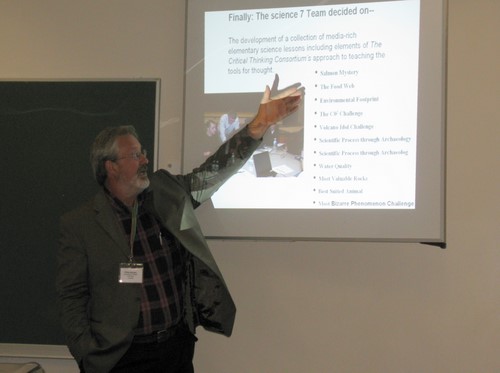
At ICeL, Philip Balcaen of the University of British Columbia (BC), Canada, spoke about embedding critical thinking into science teaching in a secondary school project in BC. His presentation, titled Developing Critically Thoughtful, Media-Rich Lessons in Science, highlighted the need to develop critical thinking skills amongst youth, even while many educators who claim to be in this space do not have a sufficient understanding or definition of critical thinking.

In his paper he outlines a conceptual framework to create critically thoughtful and media-rich science learning resources. The framework is based on a model of critical thinking developed by the Critical Thinking Consortium.

This model supports critical thinking by embedding the teaching of five categories of intellectual tools into the curriculum content. The “tools for thought” include: addressing the need for focused and relevant background knowledge, criteria for judgment, thinking concepts, thinking strategies and the development of habits of mind. Ultimately this approach will develop teachers who can provide ongoing support to the process of inquiry that they have begun.

Philip Balcaen

Philip (above) believes that these “habits of the mind” need to be made explicit outcomes of a lesson. We have planned to discuss this matter further, once he has returned to Canada. The approach used in his framework has great relevance for Kusasa and its lesson formats.

Technology-assisted reading: a helping tool in our crisis

Given that South African learners are of the poorest readers in the world, how do we improve their reading skills using technology? This was the question posed by Gerda van Wyk and Arno Louw of the University of Johannesburg in their ICeL paper: Technology-Assisted Reading for Improving Reading Skills for young South African Learners.

Apparently improving the reading skills of learners through technology-assisted reading programs is a controversial issue: those against it argue that reading on a screen will not improve reading on paper and that screen reading is not a “normal way” of reading. However, there are many voices for it, who acknowledge the role that technology can play in administration, evaluation and being adaptible to learner skill changes.

In an attempt to assess the efficacy and appropriateness of this approach for South Africa (SA), the authors conducted a study with grade 2-7 learners from an Afrikaans medium primary school. The 31 learners in the study came from middle to low socio-economic backgrounds. During 15 sessions — over a period of seven months — the learners followed a combination of a computer-based reading program (software: Reading Excellence), visual accuracy and visual memory computer exercises (software: Lector), as well as the application of specific paper-based activities. Groups were small, with continuous personal intervention and communication from the facilitator with each learner. The reading software automated a spelling test, reading technique exercise, comprehension test and language exercises.

Based on continuous assessment of learners’ performance, specifically reading speed, reading comprehension and spelling, overall improvement was significant. Learners were assessed according to their grade: for reading comprehension the lowest improvement was the grade 3s (18%) and the highest improvement was seen by the grade 4s (65%). For spelling, grade improvements ranged from 19% to 65%. While word improvements were notable, most of the learners still read slower than expected for their grade level.

From interviews, the following overall improvements were identified:

  • Parental feedback:
    • Learners use newly learned words at home during conversations.
    • Learners asked for books from the library for the first time.
    • Learners reading for the first time during school holidays.
    • A general increase in school marks.
    • A change in attitude towards reading and excitement about the reading programme.
    • An improvement in reading speed and reading fluency.
  • Teacher feedback: learners’ confidence improved. Grades in unrelated learning areas improved.
  • Facilitators feedback: the better learners helped poorer readers, open collaboration occurred.

The authors quote Osche (2003) as follows: “Perception of one’s own abilities influences achievement or failure.” As factors contributing to the success of the project, they list: individual attention to each learner, and support from the teachers and parents. The software allowed the learners to work on improving their skills privately, and not through reading in front of a class, something that can have very negative effects on learners’ self-perceptions of their reading abilities.

The presentation was very interesting and I hope to engage the authors as they continue with further research in this space. Their conference paper concludes as follows:

“The results of this study indicate the importance of adapting our teaching methods in order to address the reading crisis in the country. Computer-based reading programs are effective and fairly quick in addressing the reading problems of young learners.”

Indeed, there seems to be real potential for making a significant change in education in SA.