We are pleased to announce that the Kontax series is now also available on the MYMsta mobisite. MYMsta, short for Make Your Move, is the world’s first HIV/AIDS related mobile social network. It’s a project of LoveLife, based in South Africa.
We will continue to experiment with publishing approaches, e.g. MYMsta has a 1,000 character limit on its content pieces (to keep data costs down for its users), so the Kontax story will be published in smaller chunks than the usual chapter length. Two installments will be published every week for now. There is no manual for mpublishing — we can only try different approaches to see if they work or not!
Thank you to Duncan Harling at LoveLife for working with us and publishing Kontax.
The first TEDx Soweto happened on Freedom Day — 27 April in South Africa — appropriately held at the Apartheid Museum. The theme was “The Age of Participation”.
It was a fun and interesting day, with lots of different perspectives and stories — less of a technology focus than the usual TED formula, which I think really worked. A key theme throughout the day was the highly differentiated society of South Africa, with so many people not really having access to meaningful participation in the Web 2.0 way that many of us in the audience do. Not everyone has an iPhone, not everyone watches YouTube. I spoke about literacy in the age of participation, mainly covering the findings of the m4Lit project and the huge potential of mobile phones for literacy development in Africa. A key point I made was that in the developing world participation for most people will happen through mobile phones.
Highlights
For me the following speakers and messages were highlights. Speaker bios and links are on the TEDx Soweto site.
Khaya Dlanga, blogger, ad exec, youtuber and general good guy, told his life story (in a very funny way!) — about a rural herd boy form the Transkei who, by the age of ten, had already kicked a marijuana habit; who had to drop out of advertising school because he couldn’t afford the fees; and about his first CV, based on which he was immediately hired. It was for a copy writing job and contained something along the lines of:
I’m black
I don’t belong to COSATU
Some of my best friends are white
I used to write FREE MANDELA and ONE MAN ONE VOTE on school walls
As you know, that was a very successful campaign
When he first started posting videos on YouTube — before he became famous — he deliberately used an oblique username so that he wouldn’t be recognised (“Back then it was embarrassing to post videos of yourself on the internet!”). He spoke about the need to create a narrative about yourself on the web before others create one about you. Think about what your strengths are, who you want to be, and be it. He ended by recalling how this herd boy came to ask Barrack Obama an interview question via YouTube, clearly an achievement he is very proud of!
John Perlman, radio presenter and football philanthropist, spoke about the Dreamfields project, his way of getting involved in the 2010 Soccer World Cup. Dreamfields provides sponsored sports kits (Dreambags) to school kids in South Africa. Everything to kit out a whole team is in the Dreambag. They also build soccer fields and hold regional tournaments. One school to which they gave the kit beat Morocco Swallows U19; another of their teams became provincial champs within 6 months. It’s an awesome project that is making a real difference in the kids’ lives. The bit I liked the most was that Dreamfields is not about finding the next Ronaldo or Kaka or Lucas Radebe. Rather, it’s about helping kids have a dream and be the best at whatever they do, whether they become Constitutional Court judges, CEOs of top companies, plumbers or carpenters. There are many roles in society that all need filling — the key is to be the best at whatever you do. Go John!
Steven Newton, head of Google SA (not for much longer though), spoke about the need for relevant, affordable content in Africa, which will be accessed via mobile phones. He’s not too worried about the issue of access to mobile phones — that’s a problem that can be solved (I agree — mobile phones present more of an effective use than an access issue).
Simon Gear, environmental scientist, offered a way for each individual to do their bit to arrest climate change. He asked us to picture a triangle with health, wealth and happiness at the corners. Through examples he showed that by improving any 2 of the 3 of those, the environment will be helped. For example, by going for a walk in a park you improve your health and your happiness. Well used parks are better looked after by the municipality, so the environment is helped. Or by eating less meat every week you improve your health and your wealth (veggies are cheaper than meat). “Factory farming” of animals is reduced this way — so the environment scores. On the issue of happiness, he pointed out that people who spend their money on experiences are happier than those who spend it on things. Basically, we need to buy less and do more.
There were interesting ideas through violin sounds from Samson Diamond, the Standard bank Young Artist of the Year for 2010. Along with his sister and another co-performer, he made beautiful music to demonstrate that it takes different sounds (people) to work together in a way that is harmonious (like a true society should be).
We were taken on a dreamy journey through the three principles of drawing by Khaya Mtshali, graphic designer, lecturer and wise young soul.
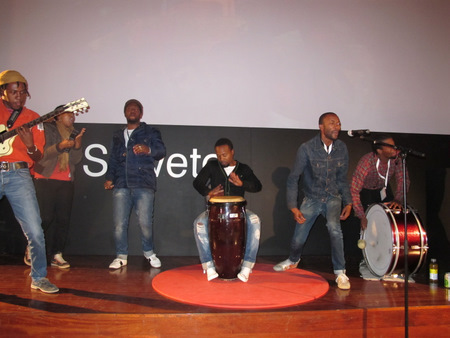
To end the day BCUC gave a blistering performance — one 25-minute song that left the performers sweating!
BCUC (Image: Steve Vosloo, CC-BY)
Lolights
One or two participants didn’t stick to the time schedule (obviously not familiar with the strict TED approach). They also could have made more of a point, a message. I wasn’t sure what the big idea was that they thought was worth spreading (the TED motto).
Overall, though, I thoroughly enjoyed it and found it a valuable day. Big up to the TEDx Soweto team for organising the event (and self-funding it after potential sponsors dropped them at the last minute). The organisers pointed out that they’ve had to really sell TED as a concept. For so many of us TED is the standard for big ideas and compelling presentations. No sell necessary. We all need to do our bit to raise awareness in SA of the value of the TED model, and the exciting potential of holding our own TEDx events. African solutions to African problems!
I really look forward to attending future Soweto TEDxes!
At the World Bank’s Innovation Fair “Moving Beyond Conflict” event in Cape Town, Parvathi Menon, the CEO of Innovation Alchemy gave a short but very insightful presentation on innovation. A key question she asked was: What are the series of innovative ideas that together make an innovative proposition? People often stop at the first idea and think that’s the innovation. Don’t do that! The iPod was the platform not the key innovation. The killer “app” was being able to buy a song at a time for 99c and easily drop it onto a player.
Africa is book-poor but mobile phone-rich, so m4Lit‘s idea to use phones as a way to get teens to read and write is an innovative one, right? No. Applying Parvathi’s points to m4Lit: for our readers the innovation isn’t reading and writing on mobile phones. It’s reading kick-ass stories, affordably, easily (they always have their cellphones with them, they don’t always have books or magazines with them), and being able to make comments and have the world see them in near real time (beats writing a snail mail letter to the author). These are the “layers” that make up the innovative proposition. The mobile phone simply enables all of this. Key to realising the innovative proposition is telling readers that the stories are there — so need to market effectively (and innovatively) — and quickly moderating readers’ contributions.
On Saturday 15th March the Reading Association of South Africa held a conference called “Literacy Works: Best practices in literacy teaching and a focus on mew media: their place in literacy teaching” at the University of Cape Town. It was an informative day, with everyone there clearly enthusiastic and committed to improving the literacy levels of South Africa’s youth.
Texting and literacy Kevin Sherman, an ICT Education Specialist at the Schools Development Unit, University of Cape Town, spoke about using text messaging to teach literacy skills. It was a fun session where various groups had to translate conventional English passages to txtspk and back again. Afterwards we thought of all the learning activities that we’d employed in the exercise — a list of about 20 points. When weighing up this list against the negatives usually associated with texting, e.g that it might be bad for spelling and grammar, the positives very much won.
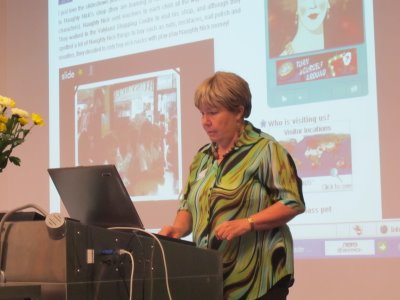
Primary school teacher, Fiona Beel, talking about how much her learners have enjoyed blogging (License: CC-BY-NC-SA)
Mobiles for literacy
I spoke about the m4Lit (mobiles for literacy) project, presenting an overview of the project findings. The presentation and research reports will be launched on Wednesday, 17 March. What was interesting is that nobody in the audience during Kevin’s talk or my talk was opposed to texting and using cellphones to get kids to read and write. Usually there is the voice of dissatisfaction in the audience, but not a single one on Saturday. One of the teachers did mention, however, that his school has a strict ban on cellphones, so learners would need to do their cellphone reading and writing after school.
Education reform
The day started with a presentation by Dr Ursula Hoadley, who was part of a task team organised by the Minister of Basic Education in 2009 to review the implementation of the Curriculum 2005 (1997), Review of C2005 (2000) and the National Curriculum Statement (2004). The committee traveled around the country, listened to teachers’ complaints and suggestions for change. What they found was massive confusion around the different policies, and therefore inconsistencies in the way these were implemented.
Over the last decade, in the classroom there has been a focus on group work, the construction of learner knowledge, and a marginalisation of textbooks. The policy focus has been on the “how of teaching,” with a neglect of the “what of teaching” — and this has resulted in problematic practices in the classroom. Teachers complained that they didn’t know what they actually had to teach!
Some of the committee’s recommendations include:
Streamline and clarify policies:
Single document per learning area/subject per phase, grade R to 12.
Design clear, succinct, unambiguous policy and guidelines in clear language, e.g. get rid of “learning areas” and “learning programmes”, and replace with “subjects”.
Reorganise subjects and time allocations in the Foundation Phase (FP) to give more prominence to languages and mathematics.
The abandoning of Learning Outcomes (LOs) and Assessment Standards (ASs) as curriculum organisers — from OBE. LOs and ASs have not shown to effectively mark learning progress for learners and also draw teachers into bureaucratic box-ticking.
Learning and Teaching Support Materials (LTSM):
That a national LTSM catalogue be produced. BUT there are also too many textbooks in the market — need to rationalise and ensure quality.
That the role of textbooks be reasserted.
A textbook for every learner for every subject in every grade.
A return to a focus on content and clear guidelines on what needs to be implemented and how — a “return to syllabus”.
The Minister of Basic Education wholeheartedly accepted the report. Now it needs to be implemented. The bureaucratic machine of government, and the tensions between the report’s recommendations and existing laws and policies is making implementation a slow and uncertain process. Much heated debate is raging at the moment, e.g. the argument for state control of publishing, e.g. one textbook for a particular subject per grade, as opposed to a choice of 16 different textbooks offered at the moment.
The audience noted that we should be aware of binary thinking towards policies, where the pendulum now swings away from “process” back to “content”. Ursula responded that the report was not a pendulum swing where practices that are appropriate in certain settings, e.g. groupwork, are thrown out wholesale. The report is an attempt to address the criticisms and failures of the last 15 years, to make it simpler and easier for teachers to teach.
There is a justified obsession with mobile in developing countries. There are far more mobile phones in the developing world than the developed, and therefore a delivery device in nearly every pocket.
Mobile phones know where you are, what time it is, are communications devices and are fully programmable. Starting question: Given these features, what story can you tell?
The Carrier is the first transmedia graphic novel as an iPhone app. In it’s “print” form, the novel would consist of 680 panels, 35 chapters — about 120 pages if printed out. Really it’s just images on a screen. But given the transmedia way it is told — in real time over 10 days — the story is a lot more.
Because mobile phones know what time it is, stories can be revealed over time. Depending on the time of day that reading begins, readers begin the story in a different way. This puts the storyteller in control. In real time the story pushes out messages.
The authors have created a lot of fictional sites — alternate reality game-like. They also created merchandise in Cafe Press that they linked to, which readers could buy. Messages were pushed to iPhone readers using Urban Airship (first 250,000 messages sent a free!) Geoff considered using SMS for messaging, but that option was too expensive (the author pays for the messages, not the reader).
This was an interesting presentation, given the transmedia features and story extras we built into Kontax.
The last session last night at O’Reilly Publishing Tools of Change (TOC) conference in New York was A Conversation with Ray Kurzweil and Tim O’Reilly — an extremely interesting conversation between two very bright minds. “Ray Kurzweil invented the first CCD flat-bed scanner, the first omni-font optical character recognition, the first print-to-speech reading machine for the blind, the first text-to-speech synthesizer, the first music synthesizer capable of recreating the grand piano, and the first commercially marketed large-vocabulary speech recognition. Ray’s latest book, The Singularity is Near, was a New York Times best seller.”
Ray’s latest product is Blio — a free ereader. It has 1m free books + some paid for books in its catalogue. Blio is very interactive: audio, video, quizzes, annotations, various views, very impressive text-to-speech. For audiobooks, can sync audio with text (as word gets read it is highlighted — karaole style). Very cool! Blio books are actually online (web-based) so they can be updated by authors at any time.
I know that a major publisher in South Africa will be using the Blio to distribute its content (when the Blio becomes available).
There are millions (billions?) more browsers than ebook readers, so why not use the browser as an ereader? (This is the approach we took with our m-novel Kontax.) You can walk into a bookstore and buy any book. Not so with ebooks, e.g. Kindle locks you into ebooks from Amazon. Google no like … Google Books mantra: buy anywhere, read anywhere. So Google moves into the ereader market with Google Editions — it’s browser-based and in the cloud (of course)!
How it works: Users preview book on Google.com. They can buy the book directly from Google.com or through retailer site. User then owns a Google Edition ebook. All users books will then be online and accessible anywhere, anytime in the cloud in their Google Books library. Further:
eBooks will be full colour (they were scanned in colour)
Social features / sharing margin notes
Seamless reading between devices
Using HTML5, users can also read offline
Simple ereader interface in the browser
Will support DRM and DRM-free content (depending on publisher requirements)
Will allow copy/paste/print or not (depending on publisher requirements)
Revenue split when buying directly from Google Books: 37% to Google, 63% to publisher
Territory rights of the publishers will be respected (not sure how they’re going to do this)
You’re not locked into Google if you buy their books.You can take the files with you if you leave. And devices should be able to access the open-standards data. Google Books is part of the Data Liberation Front at Google
Ideas: bundling ebook with print book
The Google eReader will launch in 2010, mostly likely in the early part of second half of the year
Abe: “This is a great year for ebooks and Google’s gonna be part of that.”
OK, so this is all very interesting. Yes, Google will still be a controlling party in the value chain (let’s not forget that they make money … they don’t just love freeing information for the love of it). But their control will be less restrictive than current publishers. Definitely a space to watch.
How can digital innovation provide premium reading experiences?
The future of publishing can be summed up in one word: change.
Questions: What will the publishing value chain look like in 2013? What skills will be needed? What will you do about it today?
Law is not a business solution William Patry, Google Inc.
People say that you can’t compete with free. Wrong way to think. Provide something of value to people and they will pay for it.
Are ebooks dead? David Skip Prichard, CEO of Ingram Content Group
USA teens aged 8-18 spend 7.5 hours / day in front of an electronic device. How will publishers engage this generation?
Simplify: know what your business value add is and focus on it (differentiate). Limit the variables. (More options does not translate to increased sales.)
Publishing is dead: Long live publishing! Ariana Huffington, co-founder and editor-in-chief of The Huffington Post
Books don’t end in print. They’re conversation starters. Reviews are conversation enders. What people want are conversation starters.
The medium is definitely not the message.
We have entered the golden age of engagement. Publishing needs to combine best of old and new worlds.
We want reading to be social (community) and engaging (interactivity) (see our m-novel Kontax). Enhanced Editions has affirmed this approach.
We’re reaching teens where they are — on their mobile phones.
m4Lit should focus on one thing: bringing books to teens in developing countries through mobile phones (NOT including iPhones). Our differentiator is a user experience that is low-end device specific and cognisant of price (keeping data traffic to a minimum).
The next workshop that I attended at the O’Reilly’s Publishing Tools of Change (TOC) conference in New York was Twitter Scorecard for Publishers by Mike Hendrickson. It was an in-depth and quite technical look at using Twitter for amplification, engagement and other purposes. A few useful points:
Are there multiple twitterers in your organisation? Should they be rolled into one account? Do they say the same thing all the time? Or, ideally, do they NOT share the same followers/following, in which case they reach distinct audiences and so should be kept as separate, independent accounts? Use InterTwitter to find out.
What kind of a Tweeter are you: casual, connector, climber or persona? Who influences you? How much Twitter clout do you have? Klout.com will tell you.
See who you’re following but who aren’t following you back with Friend of Follow.



 Because mobile phones know what time it is, stories can be revealed over time. Depending on the time of day that reading begins, readers begin the story in a different way. This puts the storyteller in control. In real time the story pushes out messages.
 Steven Vosloo