He spoke about three types of increasing complexity in popular culture experiences: content, participation and interface.
Of interest to me was what he said about LOST. The TV series LOST is very complicated: lots of characters, inter-related narratives, cryptic clues, etc. He argues that it’s one of the most complex series of all time. The TV creators of today are able to take this non-interactive medium and conceive it as an interactive one, because they can rely on collaboration between participatory viewers who discuss the show on the web.
People also say that the attention span of the youth is reducing in today’s popular culture world. Not so, says Johnson, as he compares the time it takes to read a book, play a game, watch a TV show and follow a blogger. The book, which apparently young people don’t read anymore because they only respond to quick interactions, actually demands the least amount of time when compared with other popular activities of youth. Interesting.
First up: Andrew Pinder, Chairman of Becta, which focuses on how to use technology to support teaching and learning in schools. It will launch a “surge” to address the lack of effective and productive use of technology in schools. Why? Because research proves that, when correctly used, technology does support educational attainment and raise grades. For young people, probably the only time they’re not using technology is when they’re in school. This is puzzling and demotivating for them, especially as they know that ICT literacy is required for 95% of jobs.
The forthcoming campaign — called Next Generation Learning — is aimed at teachers and parents, to demonstrate the benefits and necessity of using technology in education. They will also lobby government to ensure home access for all. Not PCs for all, but affordable access through any device with a screen. They are talking to the corporate sector to put together packages for low-income homes. They are interested in getting a good deal for the learner that results in educational outcomes.
In January ’09 Becta is hosting a meeting of Education Departments from around the world (SA is attending) in an effort get the sentiment of Next Generation Learning being implemented globally.
A truly interesting mLearn 2008 keynote was titled Wildfire activities: New patterns of mobility and learning by Prof Yrjö Engeström, Professor of Adult Education and Director of the Center for Activity Theory and Developmental Work Research at the University of Helsinki. Engeström is best known for his work around activity theory.
In his presentation he asked the audience to reconsider what mobility really means, not just movement enabled by mobile ICTs but movement in terms of information flow, production, workplace dynamics, etc. Mobility is presented as the underpinning of wildfire activities. Read on to understand what this means … (it’s a long post, but he’s a seriously bright cookie and worth hearing out.)
Reconceptualising mobility
Kris Gutierrez (UCLA) posits that in all education there is the official script of the educator, and the often invisible counter-script of the learners. These frequently collide, but when they engage in dialogue and hybridize, we get powerful “third spaces” of learning.
Historically, mobility was directed from the periphery to the centre, from novice to master. In an industrial/production world the movement is linear, from beginning to end (assembly line, business process or individual career). But this is breaking down today.
In wildfire activities of social production, mobility takes the shape of expansive swarming and multidirectional pulsation, with emphasis on sideways transitions and boundary-crossing. Wildfire activities are seen in some web 2.0-enabled communities. But he wanted to talk about the “old” new wildfire activities, e.g. birding, and not just web 2.0 phenomena like Wikipedia.
Historicising activity: from craft to social productions
Nature of object
Locus of agency
Coordinating mechanism
CRAFT
Personal object
Individual actor
Identification and subordination
MASS PRODUCTION
Problematic object
Team
Process management
SOCIAL PRODUCTION
Runaway object (therefore never complete), e.g. Linux
Knots in mycorrhizae (Think “legitimate peripheral participation” (Levine and Wenger, 1991))
Negotiation and peer review
What are wildfire activities and why they’re important?
Humans and organisations are seeking models that enable continuous, engaged, self-renewal, innovation and expansion, yet are sustainable and don’t burn out over time, e.g. skateboarding, bird watching and the emergency relief arm of the Red Cross.
Paradoxes of these activities:
Discontinuous but demonstrate longevity and persist over time
There is no mechanism that forces them to continue
Dispersed and distributed, yet well co-ordinated and aware of the whole in each node
Participants are offered little publicly recognisable rewards but are highly motivated
Important characteristics:
Resistant to thorough commercialisation
“Gift economy”, peer-to-peer or social production
Quick adoption and creative use of up-to-date ICTs, but little emphasis and depedency on them; no closed world of virtuality
Are not:
Just wikinomics or large numbers of people doing something together
Just open source
Just the Internet
Just social network sites
Nothing new about these communities, but almost no history or studies on them.
Communities as mycorrhizae
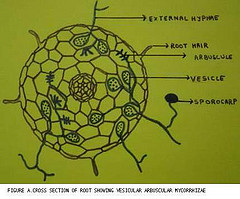
Mycorrhizae
Craft community: relatively closed and stable, dominated by tradition
Mass production community: rule-governed, relatively transparent but clearly bounded and centrally controlled
Wildfire community: mycorrhizae-like, hybrid, poorly bounded, the centre does not hold
Mycorrhizae — a symbiotic association between a fungus and the roots of a plant — is a useful metaphor. They are hard to to kill, but also vulnerable (weather pattern dependent).
Hybrid mycorrhizae as communities:
Birding: hybrid of birder and researchers
Skating: skaters, merchandise sponsors and media
What it all means for learning?
Learning in wildfire activities — a working hypothesis:
Learning is mostly horizontal that crosses boundaries and ties knots between actors operating in fractured and often poorly charted terrains
It is subterrainian learning that blazes embodied and lived cognitive trails and social bonds that make the terrains knowable and livable
Self-reflective learning (skaters video tape themselves), birder report every observation. Lots of criticality, peer-review
It is learning by experiencing high-stakes personal involvement, risks
It is both quick improvisational adaptation and long-term design
It is holoptic — as opposed to panoptic — where every node can see all other nodes. It is oriented toward a global view of events while engaged in intense local action. Access from every node, but no central control
What does it mean for education systems? We don’t know. We are only beginning the research into this. Perhaps these activities are only oddities and have nothing to teach us, but he doesn’t think so.
Further research is needed into understanding what the motivators are, and what the desirable output is. We need to think through these questions from a school perspective too.
When something changes, that requires sense making. Sense making is learning. Therefor: Learning is based on difference. Anything that shifts your location, your perspective, that is mobility and therefor that is learning.
Summary
Wildfire activities spread quickly, are hard to control, are characterised by irregular bursts of activity, are disruptive, are almost always perceived as illegitimate, contestable. Wildfire activities are a specialised form of informal learning. There is a love-hate relationship between vertical and horizontal activity communities, e.g. Microsoft and Linux. Very uneasy but necessary dialectical relationship.
The mLearn 2008 conference, held in Telford, UK, kicked off this morning. The 220 delegates come from every continent except Antarctica, and comprise academics, mobile developers, educationists, and others. About half the submissions were from outside of the UK.
This morning I delivered a keynote presentation at the Schools ICT Conference in Cape Town. The conference is attended by 500 people, mostly teachers, and is about the use of ICT in education.
My presentation The cellphone: ultimate distraction or powerful learning tool? is about the growing disconnect between childrens’ learning experiences in classrooms and outside “in the world.” I propose the cellphone as a tool that supports formal education and also informal learning, and thus as a way to span these disconnected sites of learning. (Children have multiple sites of learning, e.g. school, home, playground, etc.)
Two projects that I highlighted: Dr Math and M4Girls. Two suggested projects: an alternate reality game using cellphones and m-novels, short stories serialised into daily chapters, delivered on cellphones. The phone is used as a reading and authoring platform.
A very interesting perspective presented by Prof Anna Sfard is that Maths should not be used as a ’measure of intelligence.’ Read the piece, it’s short and thought-provoking.
An article on games and learning that appeared in the Business Day on Fri, 26 September, with some quotes from me, Alan Amory and Danny Day. Most of the facts are right 🙂
The Centre for Development and Enterpris (CDE) held a workshop entitled Doubling for Growth, to discuss ways to address the maths and science challenge in SA’s schools. A report with the same title was published last year that presented a plan to double the number of maths and science matriculants.
The workshop was meant to reflect on progress and challenges since the report, and open the discussion to a wider audience that also wants those kinds of results for maths and science.
It was attended by a number of private companies that invest in the “maths and science problem” as part of their CSR spend. They also need those graduates as future staff.
Issues:
Corporates and government are investing large sums of money but are seeing very little impact.
Interventions produce small numbers of graduates, e.g. one company supported 8 matriculants per year.
Not enough sharing of resources and efforts between players in this space.
How to measure the impact of the various singular efforts to address the problem?
Ann Bernstein, head of CDE, gave a presentation that covered the following:
Challenges in contemporary SA schooling:
Lack of accountability
Poor management
Low time on task (46% of teacher time is spent actually teaching — this should be 85%)
Slow pace and incomplete coverage of curriculum
Poor teacher competencies: precise facts about teacher qualifications in SA are not known
Maths teaching poor all the way through
Language of instruction (LOI) is not the mother-tongue language of many learners
220 Dinaledi schools (out of 400) where no impact is seen on HG maths passes
New curriculum has huge implications for teaching capacity:
2007: 275,000 SC learners doing maths HG or standard grade (SG)
2008: > 500,000 doing maths or maths literacy
Many more teachers are needed!
Far too few high performing schools:
2004-2007: SA is stuck on around 25,000 HG maths passes per year
0.5%: number of African matriculants who wrote higher grade (HG) maths and got a “C” or above (2004)
50% of public schools do not produce one single Senior Certificate (SC) HG maths pass
More than half of HG maths passes come from ex-model C schools. There is no guarantee that these schools will keep producing. They also face pressure to perform! Focus should not only be on the poorest of the poor and the low-end schools; these well-performing schools should be supported.
CDE recommendations:
To strengthen the Dinaledi programme: introduce a contract between schools and the DoE.
Identification of talented learners
New capacity in the DoE. Need strong communication from the DoE on the issue.
Teachers: test them. Need an audit and supply plan. Not enough data on this, not enough being done about it. Need more qualified teachers NOW for January 2009 — must IMPORT!
About 80% of public schools are dysfunctional. National voluntary apptitude test. Commit to get those kids to a decent school. Will need bursaries/support.
Private sector: current approach is not working, not fundamentally improving the education system. Ad hoc interventions are helpful, but not enough. The private sector must not perform the state’s role. They should use their private resources as “risk capital” to test innovative ideas that can go to scale.
Make “Doubling” a national project:
Need to strengthen and expand the Dinaledi programme
Need HG candidates from outside the Dinaledi schools
Take a “SARS approach” and create a unit to run the Doubling project: Executive leadership; Comprehensive strategy; Bigger budget and staff; and Report to parliament every year on progress
CDE proposed an ongoing private sector/foundation forum to:
Discuss and agree on advocacy points of leverage for new the government.
Discuss how to invest in the M&S problem with a “risk capital” approach, and partner with organisations that can take interventions to scale.
The BBC reports that a daily dose of computer games can boost maths attainment, according to a study carried out in Scottish schools.
The study involved more than 600 pupils in 32 schools across Scotland using the Brain Training from the Dr Kawashima game on the Nintendo DS every day.
Researchers found that while both groups — the control and experiment group — had improved their scores, the experimental group using the game had improved by a further 50%.
What’s interesting here is that most game literature likes to promote complex games as the vehicle for real learning, but this study shows that even drill-and-practice games help, if improving maths scores is what you want to achieve.
I recently attended the Rural Education Project (REP) Conference. The theme: Towards quality learning and teaching. Between 2006 and 2009, REP aims to develop the literacy and numeracy skills of primary school learners in under-resourced rural schools.
At the Rural Education Project conference
The project, part-funded by the Claude Leon Foundation, is interesting in that it did not set out to look for the one magic bullet in education, but rather aimed to critically explore and measure differentiated approaches to improving education in 38 rural case schools.
Essentially, the project is based on an experimental programme approach: which approaches work in which schools under which conditions? Levels of engagement occurred at district, community, school and classroom levels.
Cally Kuhne, REP project manager, pointed out the benefits of this approach:
Contribute to knowledge on rural development, in particular numeracy and literacy improvement, to inform practice and/or policy.
Identify contextual challenges related improving quality of teaching and learning in rural schools.
Study issues related to improving results.
Examine unique features of each school/cluster.
Enrich understanding of current practice, programmes, institutions and systems.
The final findings of REP will only be written up next year. For now the two-day conference was a taster — and an opportunity to network and share opportunities and challenges facing rural education. My conference notes provide details on the various presentations.

 The
The 
 Steven Vosloo