I haven’t blogged here for a while … because I’ve been doing a lot of posting at mLearning Africa, which I started in May. It’s about news, projects and research about mobile learning in Africa. Check it out!
I also recently attended a mobile learning summit in Zambia called Go Mobile! Check out an interview, posts and images from that.
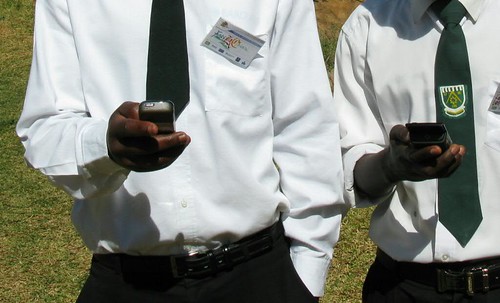
Zambian learners on their mobile phones (Source: mLearning Africa, CC-BY-NC-SA)
At mLearning Africa I blogged about the results of the fifth annual Sunday TimesGeneration Next Study. The study, conducted by HDI Youth Marketeers in conjunction with Monash University (South Africa), polled 5,272 South African youth about their brand preferences and consumer behaviour.
What is clear from the study is that youth like to be connected, entertained and to participate (consume and produce content). The mobile phone is at the heart of this behaviour — which has implications for teaching and learning in the 21st century.
In Convergence Culture, Henry Jenkins says: “Our workplaces have become more collaborative; our political process has become more decentered; we are living more and more in knowledge cultures based on collective intelligence. Our schools are not teaching what it means to live and work within such knowledge communities; but popular culture may be doing so.”
I have suggested before that participatory culture is not only an American thing, but is alive and well in developing countries. The news below confirms that, as well as Jenkins’ proposition that pop culture often moves a society towards behaving as a participatory culture. This is not a bad thing, because when we ask our learners or citizens to be participatory then they’ve been prepped in some way already.
The Star reported that DStv, the main pay TV service in South Africa, will soon be rolling out a new youth station, called Vuzu, aimed at “technically savvy 18-to-24-year-olds with a predilection for engaging viewing, combined with audience interactivity centred round MXit, MMS, SMS and the internet.”
According to channel director, Yolisa Phahle: “We can’t predict the response (to Vuzu), but we are hoping (audiences) will voice their opinions and give us feedback.”
Texting refers to the use of abbreviations and other techniques to craft SMS and instant messages. Texting does not always follow the standard rules of English grammar, nor usual word spellings. It is so pervasive that some regard it as an emergent language register in it’s own right. This is largely due to the proliferation of mobile phones as well as internet-based instant messaging (IM).
For a number of years teachers and parents have blamed texting for two ills: the corruption of language and the degradation in spelling of youth writing. Is there any good to come from this “modern scourge”? In the evolution of language, are we witnessing a major change akin to that brought about by Geoffrey Chaucer, the 14th-century author who wrote in vernacular English language, rather than French or Latin?
To answer these questions, I wrote an issue paper that explores the issue of texting, first by defining literacy, then describing the empirical research available on the effects of texting on youth literacy, which underpin the positive perspectives a number of linguists ascribe to texting. Examples of positive interventions – in classroom and informal learning contexts – that leverage the popularity of texting are outlined. Finally, research questions regarding texting in the South African context are offered. All comments welcome!
It looks like permanent teachers will be provided with laptops, via a multi-year roll-out program. This is really great news. As someone who supports the effective, innovative applications of digital media that compliment and improve teaching and learning in the 21st century, I totally support this. ICTs provide huge opportunities to support teaching, and connecting teachers to resources and each other.
But, this needs to be done properly or it will be a monumental waste of money and result in teachers being even more fearful of technology (a known problem). Warning signs from The Teacher article (linked above):
“(Pandor) realises that … the computer can catapult one over the tedious development route,” says Firoz Patel, the education department’s deputy director general of system planning and monitoring. Yes it can, but that isn’t a predetermined certainty. This kind of thinking is technologically deterministic — it believes that the machine will solve the problems. Eish!
“No face-to-face training is envisaged, but the use of software to assist training is being investigated.” I think this is a bad idea. Face-to-face training is crucial. Just ask Edunova or Khanya.
It is encouraging that between the teacher unions and analysts there is a call for comprehensive training, and monitoring and evaluation. Laptops are a necessary — but on their own — insufficient part of fixing education. Bring them on, train properly, provide content and teacher support (Siyavula is doing this) and they will play their part in the bigger process of fixing education.
Last month I gave a presentation at the National Broadband Forum in Johannesburg, South Africa (SA), on what broadband enablement would mean for education here. The forum aims to collectively produce a strategy for making broadband a priority in SA post the upcoming elections, similar to the recent bb4us campaign in America.
The presentation was blogged about on the South Africa Connect website, as well as covered by ITWeb.
See the forum day’s activities on Flickr and Twitter.
I’ve been working on a short paper on the effects of texting on literacy (forthcoming soon). Texting — SMS-speak, IM-speak, abbreviated and misspelled words, etc. — is much hated by teachers, parents and linguists who complain that textspeak is creeping into formal writing assignments — which it is. There is evidence — formal and anecdotal — of this happening in schools around the world.
My issue with this is the hysteria that has been created — the sense that a generation of youth cannot speak or spell correctly. The hysteria is based on a small number of actual textisms in essays, no more than grammar mistakes, spelling mistakes or the other inevitable mistakes that learners make when they practice writing.
The focus is on the mistake, e.g. the one textism, and not the 499 good words in an essay. The exception/mistake defines the whole piece. In the same way that when you read a book and notice a typo, you remember it. You make a mental black mark against the author and the editing process of the publishers. It’s wrong that these mistakes get made, but they need to be fairly assessed against the bigger picture of the narrative, the story structure, the characterisations, etc.
Let’s not create a whole category for texting and regard it as the death knell of English. Let’s not hysterically focus on the small mistakes. Let’s deal with them as best we can, but ask the bigger question: can young people, especially in SA, write long pieces? According to much research, they can’t because they never practice it. We need to get our kids writing, much longer pieces and more often. The few textisms need to be dealt with, but they don’t mean the end of a communicative generation.
As Aristotle said: “One swallow does not a summer make.”
Last month I had the pleasure of heading up to the Massachusetts Institute of Technology (MIT) to meet Erin Reilly, Research Director at Project New Media Literacies (NML). This is one of six research projects within the Comparative Media Studies program at the university.
The team at Project NML have come up with a list of new media literacies (NMLs) and cultural competencies that young people need to learn, play, work and live in the 21st century. Since I first blogged about the NMLs in 2007, one more has been added:
Visualisation: the ability to interpret and create data representations for the purposes of expressing ideas, finding patterns, and identifying trends.
“It’s a dynamic, living list,” says Erin. She explained that many youth today have already learned some of these competencies in social settings, but that it’s important for them to formally develop the competencies in other, constructive settings, e.g. in the classroom. Project NML aims to help create that space — wherever it may be, in school or at after school venues — to give youth and educators the appropriate language to critically think about and practice these competencies. Their work is in direct response to the emerging participatory culture in the world.
Erin Reilly and me at Project New Media Literacies, MIT
One of the issues we spoke about was how to promote the importance of NMLs to educators and parents. While Erin and I get this importance, what about those who don’t, who think a “back to basics” (traditional, non-digital) approach is what is needed in education (as is the case in South Africa)?
Erin explained that we have to present NMLs as a very effective way to develop the basics. We need to demonstrate how to effectively leverage popular culture — which is highly engaging for young people — in the classroom to develop the 3Rs of reading, writing and arithmetic.
She believes that the labels are not important, e.g. NMLs or 21st century skills. What is important are the actual competencies. We need to call these whatever necessary to get the point through. Further, we need to empower educators to create the spaces for their learners to develop and discuss the NMLs. We cannot be the experts who come into the classroom and take over from the teachers. They must be the experts in NMLs. Maggie Verster wrote an excellent blog post about how challenging it is to achieve this in South Africa.
Taking this approach — NMLs as the way to develop the basics — is an effective way to make NMLs part of the curriculum and not an add-on (which drastically reduces it’s uptake by already overworked teachers).
Another key point that Erin raised was how the team at Project NML is increasingly realising that it’s not useful to separate formal education and informal learning. While there are differences between these contexts, the educational dillemas in each are the same, and the learnings in each are easily transferred to the other context.
Finally, Erin demo’d the forthcoming Learning Library, an online play space for learners to practically develop new media literacies.
Hopefully we’ll continue to explore NMLs and work together to see how they play out in the developing world. As I’ve said before, participatory culture is alive and well in the developing world, it just looks different.




 Steven Vosloo